
In the form we know today, the passenger cable car is a mode of transport roughly one hundred and twenty years old. The idea behind it, however — carrying a load or a person suspended from a tensioned rope rather than on wheels — reaches much further back. This article follows the chronology from the ancient roots of rope-borne transport to mining lines, from the first passenger cable cars to the post-war ski boom, and finally to the urban cable car era born in Latin America.
Before the rope: the oldest solution in transport
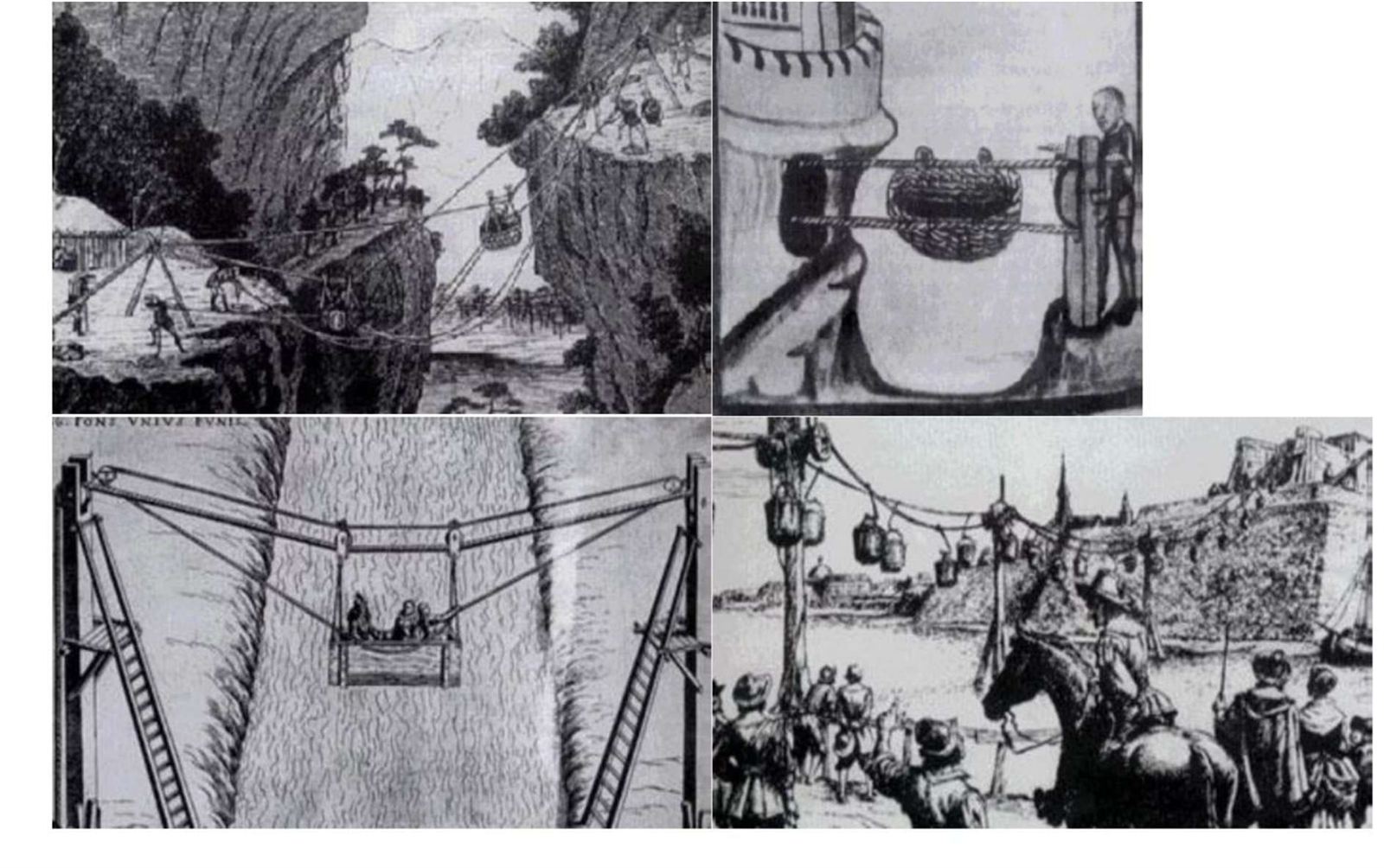
The oldest way of crossing deep valleys and rivers without building a bridge was a rope stretched between the two banks. From the foothills of the Himalayas to the Andes, from the Alps to the Caucasus, simple rope crossings carrying people and goods in baskets or slings were used for centuries across many mountainous regions. In Europe, 16th-century technical drawings show rope rigs designed for cliff crossings.
The common limitation of these rigs was the material. Hemp rope withstood neither moisture, nor abrasion, nor fatigue; chain, for its part, broke suddenly and without warning. Before rope-borne transport could become an engineering discipline, a reliable tension member was needed.
1834: the invention of steel wire rope
The true starting point of the industry is 1834. Wilhelm August Julius Albert, an official at the Clausthal mining administration in the Harz Mountains, produced the first usable wire rope by twisting iron wires into strands, and tested it for hoisting ore at the Caroline shaft. Albert’s rope could carry a far heavier load than hemp rope or chain of the same cross-section; more than that, it gave a warning signal by showing visible damage in individual wires before it failed. This “advance warning” behaviour also laid the foundations of the safety philosophy of rope-borne transport.
A rapid evolution in materials followed:
- 1837 – The first wire-drawing machine was developed in Vienna; rope production moved from handcraft to industry.
- 1884 – The firm Latch & Batchelor produced a smooth-surfaced rope whose outer layer consists of profiled wires. Known as locked coil rope, this product is still used today as track rope.
From mining to industry: the era of material transport
From 1845 onwards, wire rope became the core of aerial material transport lines in mines, quarries and large construction sites. Engineers such as Freiherr von Dücker, Cypher and Hodgson, and firms such as Bleichert (Germany) and Ceretti & Tanfani (Italy), established in this period the architecture that remains familiar today: a tensioned track rope, a separate haul rope, sheave assemblies on towers, and grips clamping onto the rope.
In the same years, armies too took an interest in rope-borne transport. Field lines that could be dismantled and moved were developed so that supply on mountainous fronts would not depend on roads; these lines were used extensively on the Alpine front of the First World War. Military requirements also passed on expertise in lightweight tower design and rapid erection to civil technology.
The first passengers on rails: the funicular
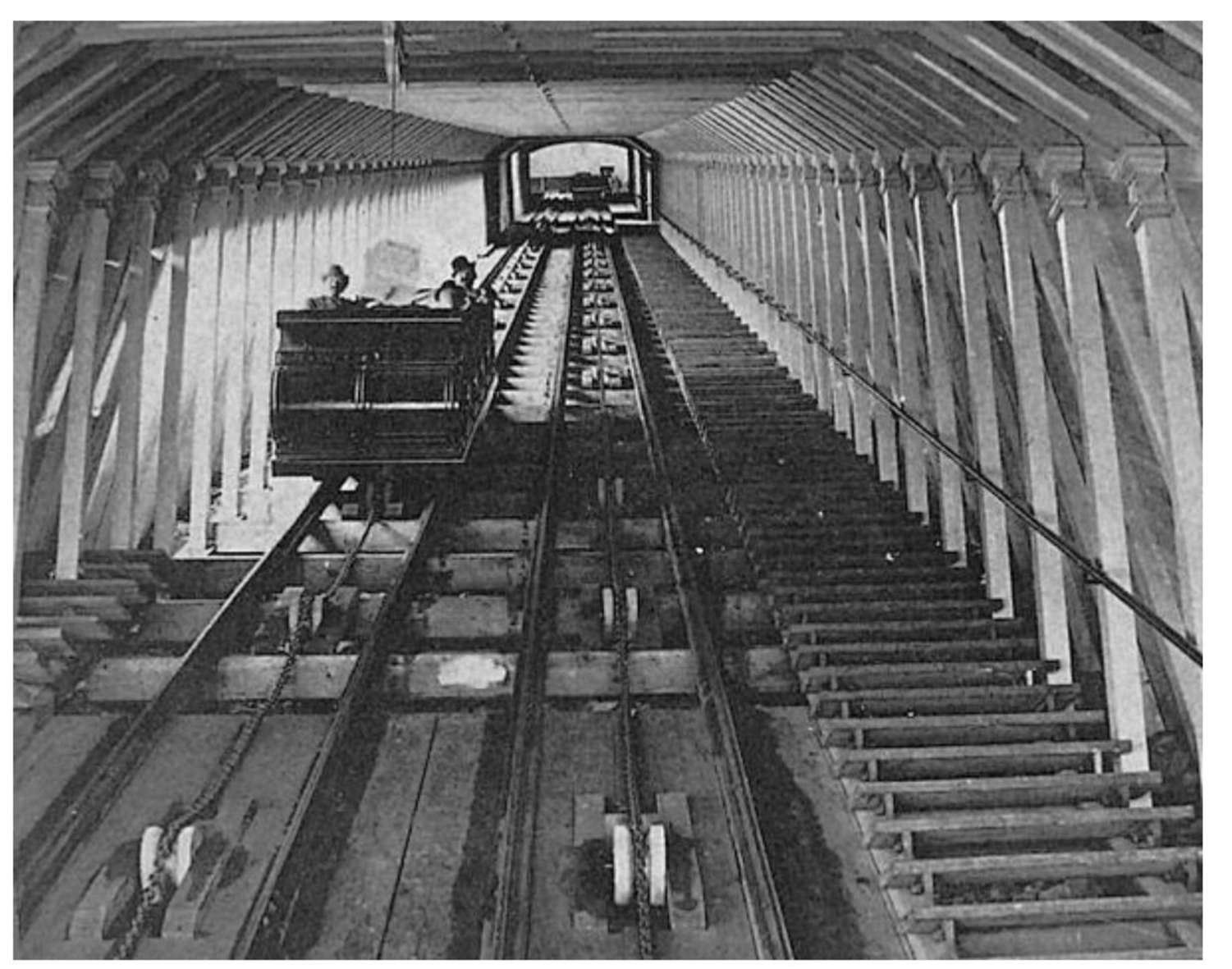
The shift of rope-borne transport to carrying people began not in the air but on the ground. Based on the principle of two vehicles balancing one another at the two ends of a rope passing over a bullwheel at the summit of a steeply inclined track, the funicular became the standard solution for cities and tourist mountains in the second half of the 19th century:
- 1845 – The Prospect Park Incline Railway at Niagara Falls in the United States is counted among the world’s first funiculars.
- 1862 – The line opened in Lyon is remembered as Europe’s first funicular.
- 1863 – The patenting of the rack system opened an alternative to the rope on steep lines.
- 1901 – A suspended funicular entered service in Dresden.
On a funicular, the descending vehicle hauls the ascending one, which keeps energy consumption low and permits safe operation even on gradients above one hundred per cent. For this reason the funicular is the member of the cable-borne family that most closely resembles a metro: platform layouts, step-free access and integrated ticketing can all be set up with ease.
1908: the birth year of the passenger cable car
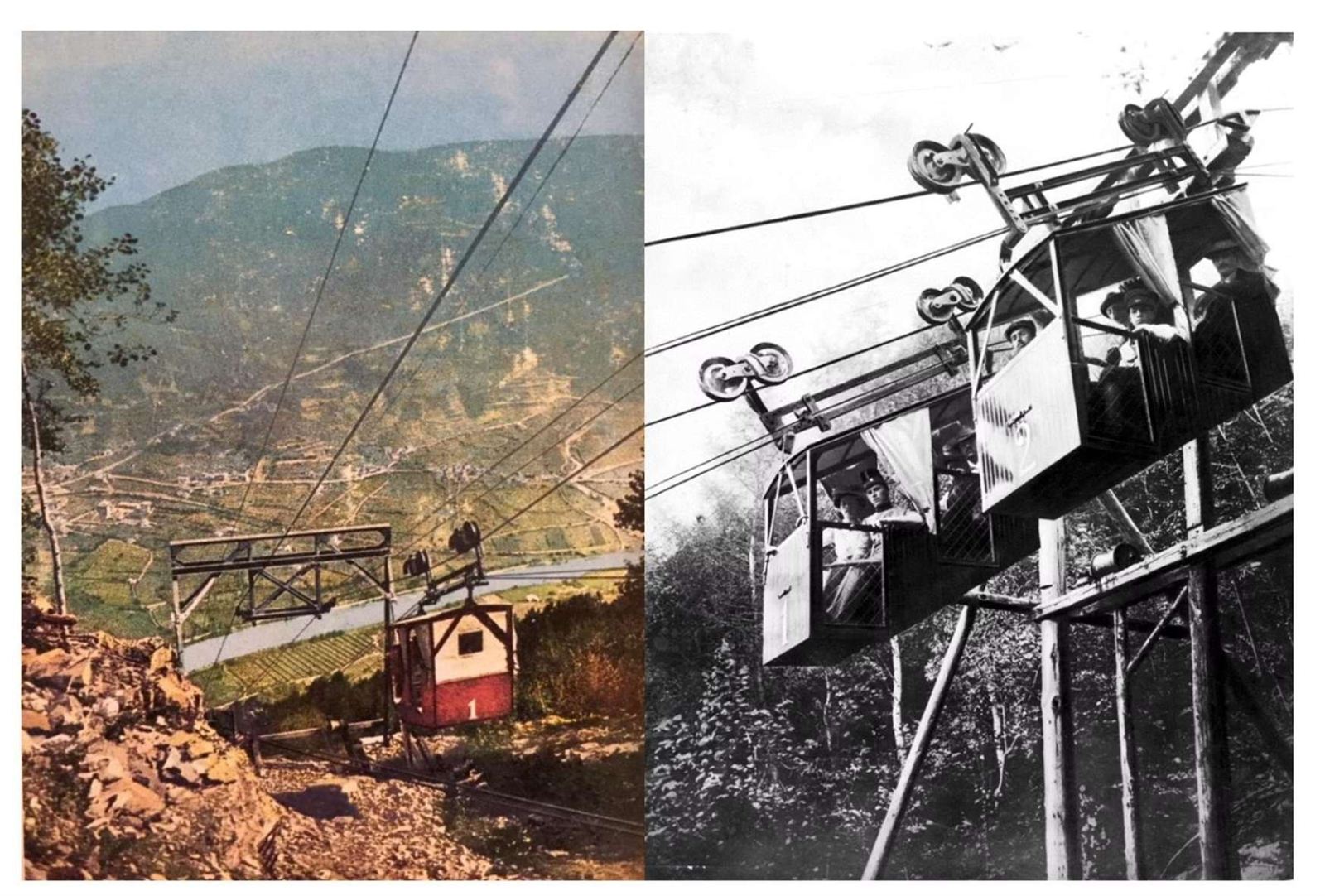
Attempts to carry people on aerial ropeways began at the end of the 19th century. Early passenger experiments such as the Monte Ulia aerial ropeway built by Leonardo Torres Quevedo in the Spanish city of San Sebastián in 1907 are counted among the pioneering examples of the years before 1908. In the United States, some early tourist aerial ropeway experiments of the late 19th century proved short-lived because of the accidents that occurred. These early experiences showed at an early date that rope-borne passenger transport was possible only with systematic calculation, dual braking and regular inspection.
The year 1908 is accepted as the birth year of the industry, and this year has two separate lines:
| Date | Installation | Notable feature |
|---|---|---|
| 29 June 1908 | Kohlern / Colle, Bolzano (Italy) | The first aerial ropeway officially licensed to carry passengers; a cabin for six people |
| 27 July 1908 | Wetterhorn Lift, Grindelwald (Switzerland) | The first electrically powered aerial ropeway designed solely to carry passengers; two cabins for 16 people each |
With its two independent braking systems and a device that cut the power in the event of overspeed, the Wetterhorn line was described in the technical press of the day as “the world’s first modern aerial ropeway system”. The line, which covered a vertical rise of about 420 metres in nine minutes, closed in 1915; the Kohlern line, by contrast, has been renewed and is still in operation today.
The infrastructure of skiing was born in the same year: in 1908, in Germany’s Black Forest region, Robert Winterhalder built the first ski tow.
Skiing and the system revolutions
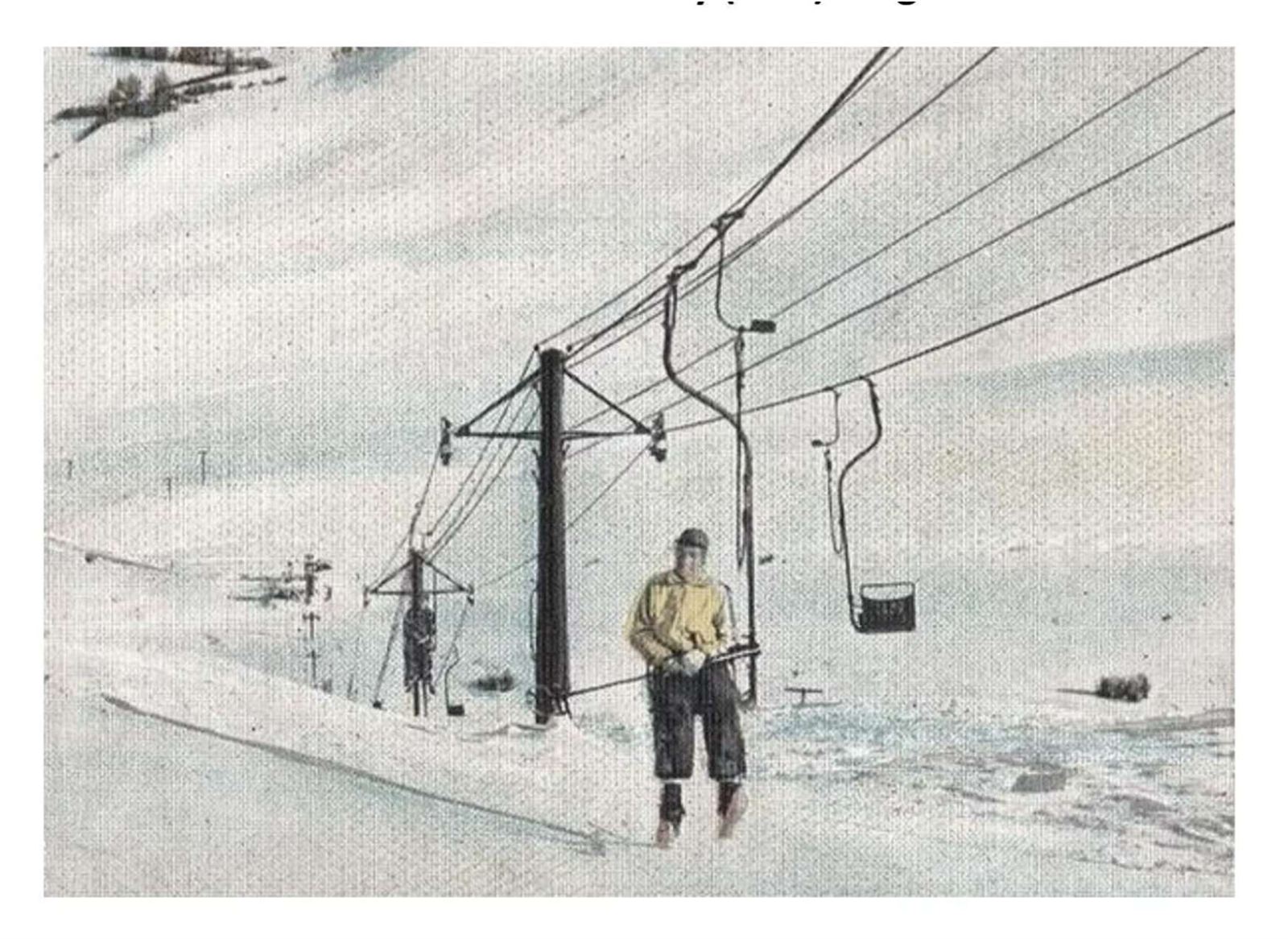
Before the Second World War, and above all after it, the mass take-up of ski tourism became the strongest driving force behind rope-borne systems. Demand forced capacity and comfort to rise quickly:
- 1936 – The world’s first chairlift, designed by Union Pacific engineer James Curran, entered service at Sun Valley (Idaho, USA). Curran’s starting point was a suspended conveyor system developed to load bunches of bananas onto wagons without bruising them.
- 1937 – One of the early surface lift installations was built at Zürs am Arlberg in Austria.
- 1945 – The first detachable grip chairlift came into service at Flims in Switzerland. The vehicle detaching from the rope and slowing down in the station was the fundamental innovation that raised line speed while making boarding and alighting safe.
- 1949 – The first gondola lift (a continuously circulating system with enclosed cabins) was implemented in Italy on the Belvedere line at Alagna Valsesia.
In the 1960s and 1970s, hundreds of installations were built in the Alpine countries, North America and Japan. In this period the real engineering race was about improving line speed, comfort and wind resistance together while increasing hourly capacity.
The birth of multi-rope systems
The 1980s and 1990s are the period that produced today’s diversity of systems:
- 1984 – The first DMC (double monocable) system, at Serre Chevalier in France.
- 1990 – The first Funitel, at Val Thorens (France).
- 1991 – The first 3S, that is, a gondola with two track ropes and one haul rope, was built at the Saas-Fee installation in Switzerland (some chronologies give 1990).
The common purpose of multi-rope architecture was wind. Seating the vehicle on two track ropes reduces swing and thus raises the operating threshold; in the ranking of wind resistance, 3S systems come out on top. For the differences between the system families, the guide to cable car and ropeway types offers a detailed comparison.
Extreme values were pushed in the same period. The Zugspitze line in Germany holds several records at once within its own category, with a 127-metre steel lattice tower, a vertical rise of about 1,945 metres and a rope span of 3,213 metres. The Schwyz–Stoos funicular in Switzerland, for its part, is known for its maximum gradient of about 48 degrees (110 per cent); its cabins rotate so as to remain horizontal along the line.
The institutionalisation of rules and standards
The spread of the technology also required supervision to be institutionalised. In the 1930s the first national ropeway regulations were written in the Alpine countries and state inspection offices were established. Founded in Milan in 1959, OITAF (the International Organisation for Transportation by Rope) provided a common ground for the convergence of national rules, the production of technical recommendations and the sharing of experience; today it works with members from a large number of countries and holds an international congress every six years.
In Europe, the second leap in regulation came in the year 2000: Directive 2000/9/EC made CE marking, notified body assessment and safety analysis mandatory. Regulation (EU) 2016/424, which entered into force in 2016, repealed this directive and established a single framework applied directly in all member states from 2018. For the details of this framework and the family of EN standards, see the article on cable car safety and EN standards.
The industry’s own reading of its history is clear on this point: although the pursuit of performance, comfort, energy efficiency, environmental impact and aesthetics has steered its evolution, the common denominator of every period is safety.
The geography of the industry
The rope-borne transport industry took shape largely around the Alpine arc. Doppelmayr, founded in Austria in 1893; Leitner, which began in Italy in 1888 with machinery manufacture at Vipiteno; Poma in France and Von Roll in Switzerland are the principal actors of this history.
The story of Von Roll sums up the consolidation of the industry well: founded in 1803 as an ironworks, the company entered rope-borne transport in 1883 with the Territet funicular, took part in the Wetterhorn line, delivered the detachable grip at Flims in 1945 and the first 3S at the Saas-Fee installation in Switzerland in 1991 (some chronologies give 1990); in 1996 it transferred its cable car division to Doppelmayr. The French firm Poma, meanwhile, joined the Seeber Group (today HTI), the owner of Leitner, in the year 2000; the two firms are still run as separate brands today.
The urban cable car era
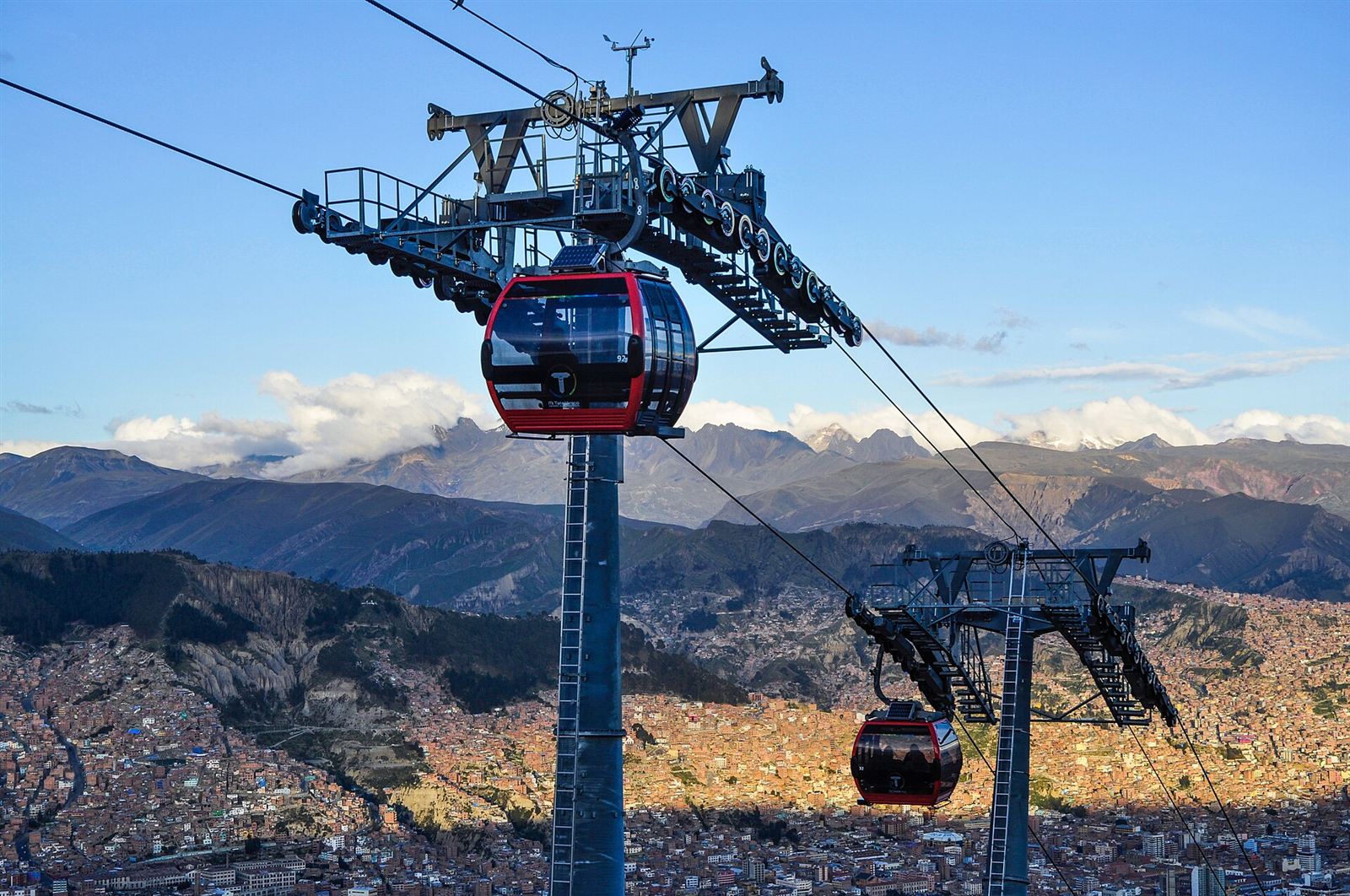
The newest and most distinct break in the history of the cable car is its descent from the mountain into the city. Where topography makes a metro or a bus expensive or impossible, a rope-borne system can cross valleys, rivers and dense urban fabric on a straight line.
- 2004 – Medellín (Colombia): The Metrocable Line K, roughly 2 kilometres long, became the first cable car line to be fully integrated into the fare and operating system of a metro network. Journeys that took hours in the hillside neighbourhoods came down to minutes; the network expanded over time into a multi-line system.
- 2012 – London (United Kingdom): The line crossing the River Thames was included in the city’s contactless ticketing system.
- 2014 – La Paz / El Alto (Bolivia): Mi Teleférico opened with its first three lines (Red, Yellow, Green); in March 2019 the network reached ten lines and roughly 33 kilometres, and was certified as the world’s largest urban cable car network. Daily ridership runs into the hundreds of thousands.
- 2021 – Mexico City (Mexico): Line 2 of the Cablebús network took the title of the world’s longest urban cable car line at roughly 10.6 kilometres.
- 2022 – Toulouse (France): A 3S line of about 3 kilometres connected university and hospital campuses to the city’s transport network.
- 2025 – Paris region (France): Câble C1 entered service as the first cable car line in Île-de-France, with a 4.5-kilometre route forming an extension of the metro network.
The appeal of the urban cable car comes down to a few concrete qualities: waiting times measured in seconds thanks to continuous, timetable-free flow; independence from terrain in route selection; low investment and short commissioning times compared with rail systems; the absence of local emissions; and high availability. Its capacity, on the other hand, cannot be compared with that of a metro; the cable car is not a backbone but a mode that feeds the backbone.
For the leading applications of this period around the world, the article on landmark cable car projects, and for how Türkiye fits into this chronology, the article on the history of cable cars in Türkiye, are the natural continuations of this piece.
Today and beyond
The technical agenda of the last twenty years has been built around automation and energy. The autonomous operation application (AURO) commissioned in the Swiss town of Zermatt in 2020 made possible a gondola operation monitored and managed without a permanent operator in the station. In material transport, meanwhile, ropeway lines have returned to the agenda in dam, cement and mining projects because they deliver significant carbon savings compared with road haulage.
Along this line running from 1834 to the present, the one thing that has not changed is that the entire load of the system is still carried by a steel rope a few centimetres in diameter. On how the rope works and how it transfers the load, the article on how cable cars work offers a technical introduction.
Chronological summary
| Year | Development |
|---|---|
| 1834 | Invention of steel wire rope (Clausthal, Germany) |
| 1845 | First funicular installations; spread of aerial material transport lines in industry |
| 1862 | Europe’s first funicular (Lyon) |
| 1884 | Production of locked coil rope |
| 1908 | First passenger cable cars: Kohlern (Italy) and Wetterhorn (Switzerland); first ski tow |
| 1936 | First chairlift (Sun Valley, USA) |
| 1945 | First detachable grip chairlift (Flims, Switzerland) |
| 1949 | First gondola lift (Alagna Valsesia, Italy) |
| 1959 | Founding of OITAF (Milan) |
| 1984–1991 | First installations of DMC, Funitel and 3S systems |
| 2000 / 2016 | Directive 2000/9/EC in the EU, followed by Regulation (EU) 2016/424 |
| 2004 | Medellín Metrocable: the first urban cable car line integrated with a metro |
| 2014 / 2019 | La Paz Mi Teleférico: opening of the first lines; completion in 2019 as the world’s largest urban cable car network |
| 2020 | First autonomously operated gondola (Zermatt, Switzerland) |