
A history that began on rails
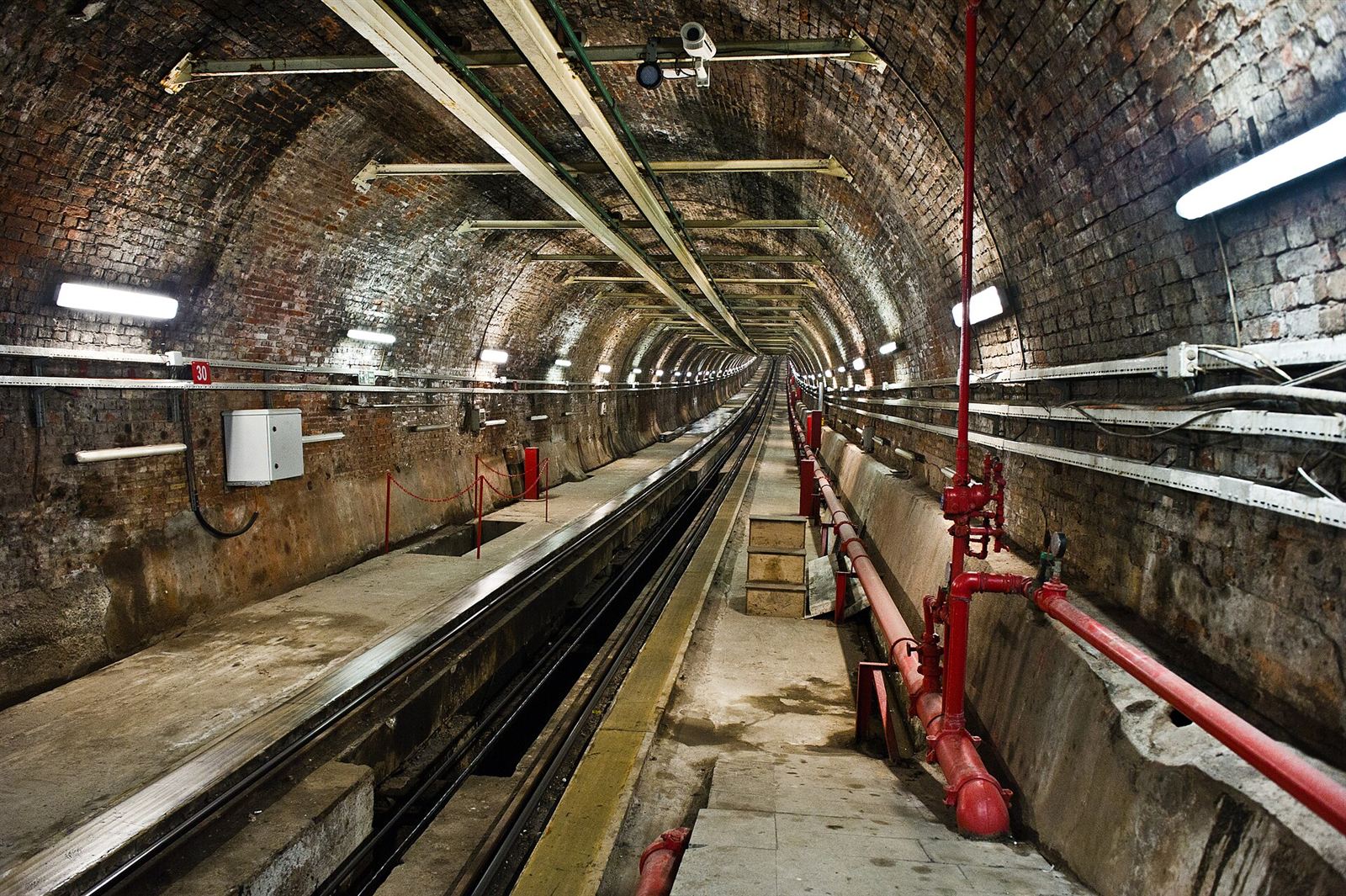
Türkiye’s ropeway transport history begins not in the air but underground. The Karaköy–Beyoğlu Tünel, brought into service in 1875, is an underground funicular of roughly 573 metres; it is cited as the second-oldest underground railway in the world after the London Underground (1863).
The funicular’s place in this story is not a technical footnote but a matter of definition. For an installation to count as a cableway, the carrier does not have to hang in the air; the decisive criterion is not the wheel but the traction. If movement is provided by a rope, the installation falls under cableway legislation even when the carrier runs on rails. The Tünel still carries tens of thousands of passengers a day today as İETT’s F2 line.
The global development of ropeway transport — from the invention of wire rope in 1834 to the first passenger cable car in 1908 — is a separate subject; for the detail, see the world history of cable cars. Türkiye joined that line of development with aerial installations in the middle of the twentieth century.
The first aerial line: Uludağ, 1958–1963
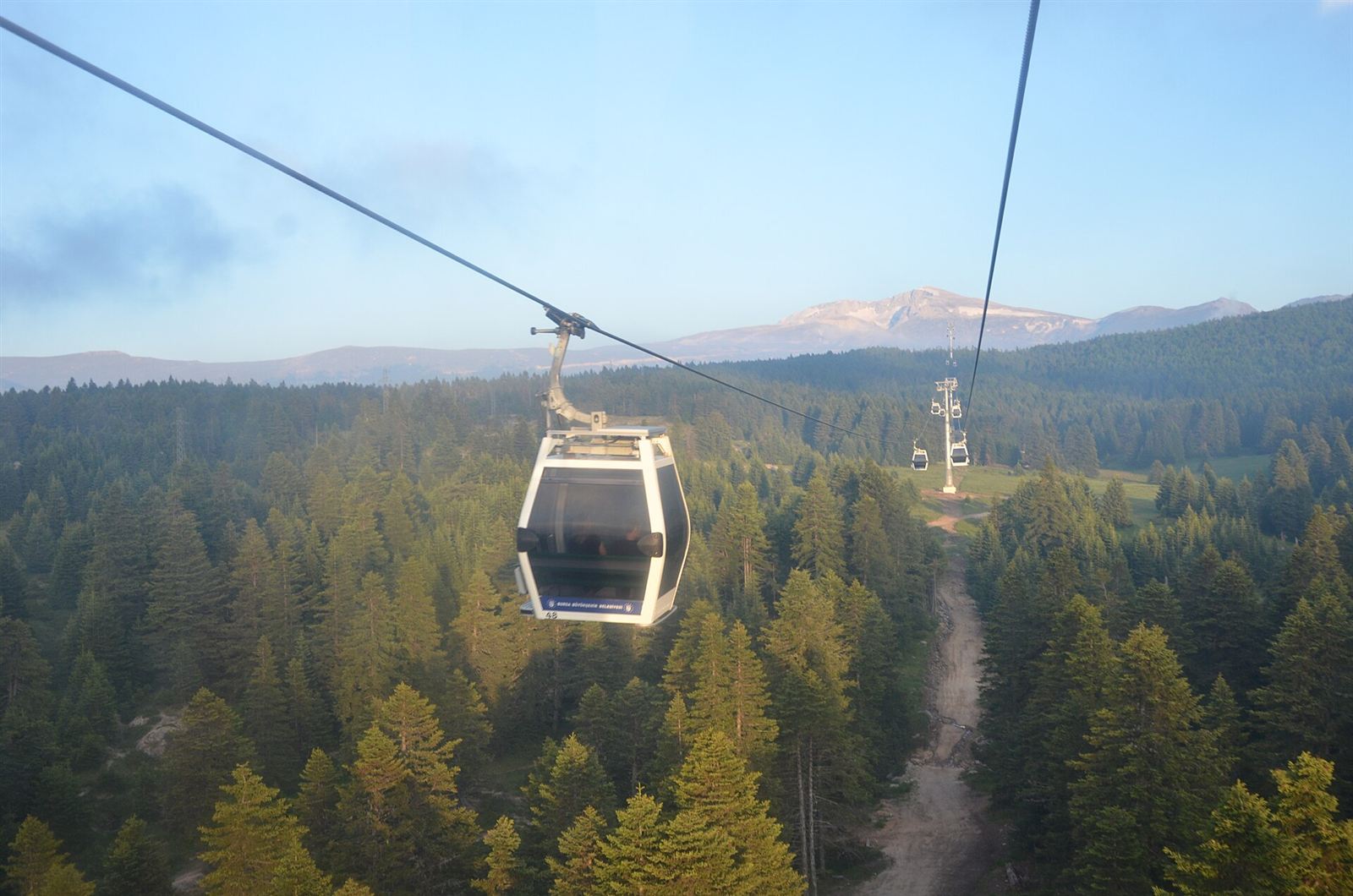
Türkiye’s first cable car is the Bursa–Uludağ line. Von Roll, the Swiss company that won the tender, was the firm behind landmark installations of the same period such as Wetterhorn and Flims. Construction began in 1958 and took five years; the line opened on 29 October 1963, the fortieth anniversary of the Republic.
The original installation was an aerial tramway (reversible ropeway): two cabins of twenty people each, working in opposite directions over a line of roughly 4.5 kilometres. The system’s site engineer, Hubert Sondermann (1902–1976), came to Bursa in 1958 and stayed in the city; he learned Turkish, advised in later years on the chairlift projects of the hotels at Uludağ, died in Bursa in 1976 and, in accordance with his will, was buried in the Emir Sultan Cemetery. For anyone working in the industry, details of this kind are a reminder that engineering history is not made up of technical data sheets alone.
The line was completely renewed by LEITNER in 2014. The new installation has 8.8 kilometres of horizontal length, roughly 1,400 metres of vertical rise, a capacity of 1,500 persons per hour, between 44 and 49 towers depending on the source, 156 cabins and 4 stations; its official opening took place on 7 June 2014. On the day it opened it was the longest monocable gondola line in the world. The same alignment thus twice went beyond the national scale, 51 years apart. For a detailed data sheet of the line, see the Bursa Uludağ cable car.
Ski resorts: from T-bar lifts to detachable chairlifts
In Türkiye the largest share of ropeway systems by number belongs to winter sports. Their spread can be read broadly as three waves:
- The early period (1960s–1980s): T-bar lifts and low-capacity fixed-grip chairlifts installed around hotels and pistes. A significant proportion of the installations of this period have today either been renewed or taken out of service.
- The expansion period (1990s–2000s): the institutionalisation of the ski resort concept; a rise in the number of pistes and mechanical installations at resorts such as Erzurum Palandöken–Konaklı, Kayseri Erciyes, Bolu Kartalkaya, Kastamonu Ilgaz and Kars Sarıkamış.
- The modernisation period (2010s onwards): the spread of detachable chairlifts and gondolas; equipment such as bubble chairs, seat heating and automatically closing safety bars becoming standard.
For the system families and the differences between them, the guide to cable car and ropeway types offers a detailed comparison.
Urban and tourism lines
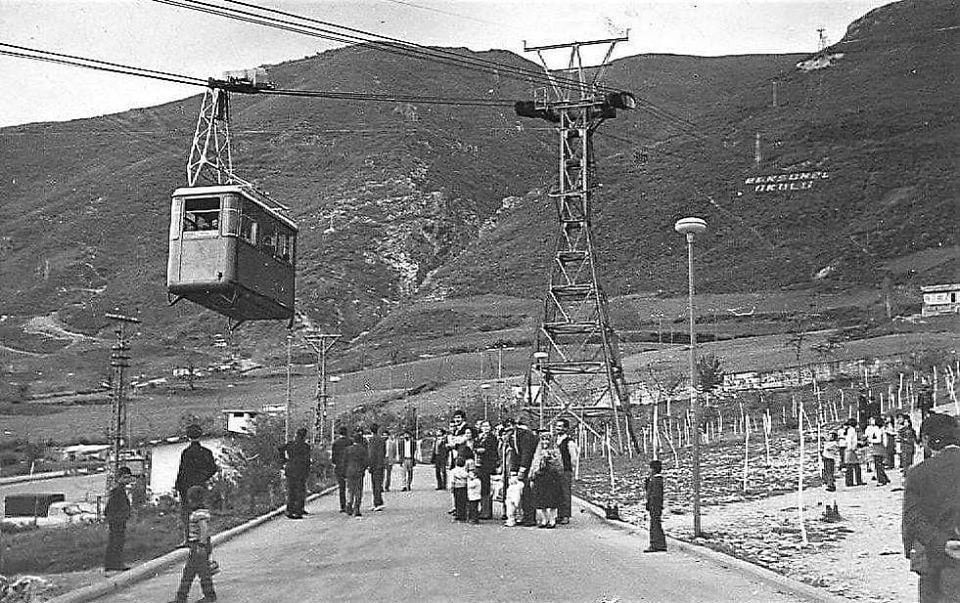
İzmir Balçova (1974)
The Balçova line is among Türkiye’s first urban cable cars; it entered service on 24 March 1974. The installation was closed on safety grounds in 2007–2008 following a report by the İzmir branch of the TMMOB Chamber of Mechanical Engineers; after a comprehensive renewal it reopened on 31 July 2015. Interruptions to operation continued after the reopening as well. It runs with a rope length of roughly 810 metres and a capacity of 1,200 persons per hour.
The Balçova case shows that the history of cable cars in Türkiye is not merely a “list of openings”: for ageing installations, the decision to modernise or to withdraw is an inseparable part of that history.
Istanbul
- TF1 Maçka–Taşkışla opened on 11 April 1993; it is a short gondola line of 347 metres with 42 metres of vertical rise.
- TF2 Eyüp–Piyer Loti opened on 1 November 2005; it is a tourist line of roughly 420 metres with views over the Golden Horn.
Both lines are today operated by Metro İstanbul.
The 2000s and 2010s: the spread of tourism lines
From the middle of the 2000s onwards, municipalities began to use the cable car as tourism infrastructure for access to viewpoints such as hills and castles: Samsun Amisos (2005–2006), Ordu Boztepe (2012), Alanya Castle (19 August 2017) and Sapanca (2023) are the prominent examples of this wave.
The Alanya line is 779 metres long, has 160 metres of vertical rise, a capacity of 1,200 persons per hour and 16 cabins. According to operator data the great majority of passengers are foreign visitors; this profile shows that in tourism regions the cable car is infrastructure that earns foreign currency directly.
The Sapanca line opened in 2023; it is a gondola of roughly 1.5 kilometres with two stations, 319 metres of vertical rise and 36 cabins.
For data sheets by installation, see the compilation guide to the major cable car and ropeway installations of Türkiye.
A public transport experiment: Yenimahalle–Şentepe
Türkiye’s first cable car built for public transport purposes is the Yenimahalle–Şentepe line in Ankara. Roughly 3.3 kilometres long and with four stations, the line opened in March 2014, operated integrated with the M1 metro line and carried passengers free of charge for a long period.
The line’s story was cut short for a legal rather than a technical reason. As a result of the case brought by the Chamber of Architects in 2013, the development plan was annulled and the installation was closed indefinitely in April 2024. Şentepe went on record as an example showing that the real obstacle facing the urban cable car in Türkiye is most often not engineering but planning and the alignment of administrative processes.
Funicular lines
| Line | Opening | Operator |
|---|---|---|
| Tünel (F2) Karaköy–Beyoğlu | 1875 | İETT |
| F1 Taksim–Kabataş | 2006 | Metro İstanbul |
| F3 Seyrantepe–Vadistanbul | 2017 | Private |
| F4 Hisarüstü–Aşiyan (integrated with M6) | 2022 | Metro İstanbul |
| Milas/Bodrum (Muğla) residential complex–seafront line | 2023 | Private |
The legal status of funiculars is from time to time a subject of debate. Regulation (EU) 2016/424 and the Turkish regulation that transposes it count rope-hauled rail systems as cableway installations; the corresponding term in the Turkish legislation is “kablolu tren” (cable train). Accordingly, a funicular is subject neither to lift legislation nor to railway safety legislation.
Material transport: the unseen branch
The first field of use for ropeway systems was not passengers but the transport of materials. The largest-scale current example in Türkiye is the Yusufeli Dam construction site in Artvin: high-capacity cable cranes were used in placing the concrete of the dam body. In the construction of this structure, Türkiye’s highest dam with a body height of 275 metres, the greater part of the material was moved by rope.
The institutionalisation of the sector
2005: transposition of the EU directive
The starting point of modern legislation specific to ropeway transport in Türkiye is the transposition of the EU’s Directive 2000/9/EC. The relevant regulation was published in the Resmî Gazete on 19 January 2005 and entered into force on 19 July 2005.
2009: mandatory application and the licensing regime
Mandatory application of the regulation began on 19 July 2009. This date creates the sharpest division in Türkiye’s cable car inventory: installations built before it count as “existing installations”, those built after it as CE-marked “new installations”.
The licensing communiqué published on 23 July 2009 established the chain that still operates today:
- Building permit — from the municipality (from the governorate outside municipal boundaries); with the line project, geotechnical survey, avalanche/landslide and earthquake data and a meteorological report.
- Technical Operating Licence — jointly from TMMOB’s Chamber of Mechanical Engineers and Chamber of Electrical Engineers; with the technical file, the safety report, the EC/EU declarations of conformity and the commissioning test report carried out under the supervision of a Notified Body.
- Opening to service — together with the technical operating licence and the occupancy permit.
- Inspection in service — daily, monthly and annual checks; including magnetic (non-destructive) inspection of the rope.
2018: the 2016/424/EU framework
In 2016 the EU replaced the directive with a directly applicable regulation. Türkiye transposed this with the Cableway Installations Regulation (2016/424/EU) published on 2 December 2017; the regulation entered into force in full on 21 April 2018 and the 2000/9/EC regulation was repealed. The chain of assurance it establishes is as follows: essential requirements → safety analysis and safety report → Notified Body assessment → EU Declaration of Conformity and CE → installation licence → continuous inspection in service. For the standards side and the EN series, see cable car safety and the EN standards.
The map of authority: who inspects what
In Türkiye responsibility is not gathered in a single body; the structure is layered:
- Ministry of Industry and Technology — the competent authority for the Cableway Installations Regulation; it carries out market surveillance and inspection of installations, safety components and subsystems.
- Ministry of Transport and Infrastructure / AYGM — assesses the requests of public bodies, municipalities and special provincial administrations to build cable cars, funiculars, monorails and urban rail systems, and submits those it finds suitable for presidential approval; it examines and approves the projects and specifications of installations to be built by these administrations.
- Municipality / governorate — building permit and occupancy permit.
- TMMOB Chamber of Mechanical Engineers and Chamber of Electrical Engineers — Technical Operating Licence.
- Occupational safety legislation — periodic inspection of work equipment. An amendment made on 23 December 2025 provided that the periodic inspection of cableway installations be carried out in accordance with TS EN 1709 at intervals of at most one year. From 1 January 2027 it is envisaged that these inspections may be carried out only by inspection bodies accredited by TÜRKAK under TS EN ISO/IEC 17020.
The areas still open
Institutionalisation is not complete. The headings that recur at industry meetings and in field inspections are these:
- Pre-2009 installations. Roughly a third of the inventory was built before this date and falls outside the mandatory scope of the regulation; at these installations CE marking, a Notified Body report and a regular inspection regime are most often not in place.
- Missing documents and licences. Shortcomings in the Technical Operating Licence, the technical file or the declaration of conformity can also be seen at some installations built after 2009.
- Accredited inspection capacity. The absence in Türkiye of an accredited independent inspection body in the cable car field creates dependence on organisations abroad for oversight. The establishment of type A inspection bodies and of national test centres is on the agenda.
- A national inventory. A comprehensive installation inventory covering year of construction, manufacturer, capacity and installation type has not yet been completed.
- Personnel competence. Aligning the requirements for technical personnel with the reality of the field and with the vocational qualification certificate system is a subject under discussion.
The picture today
According to the inventory compilation TELEFERİKDER is continuing in 2026 — the figures are approximate and the work is ongoing:
| Category | Approximate number |
|---|---|
| Cable car / gondola line | 25+ |
| Funicular line | 4+ |
| Chairlift | 49+ |
| T-bar lift | 31+ |
| Total registered installations | 110+ |
Roughly a third of the records date from before 2009. In terms of operating ownership, roughly two thirds of the inventory is in private operation and some thirty installations belong to municipalities.
Summary chronology
| Year | Development |
|---|---|
| 1875 | Karaköy–Beyoğlu Tünel: Türkiye’s first funicular |
| 1958 | Start of construction of the Uludağ cable car |
| 1963 | Opening of the Uludağ cable car — Türkiye’s first cable car |
| 1974 | İzmir Balçova cable car |
| 1993 | Istanbul TF1 Maçka–Taşkışla |
| 2005 | Entry into force of the 2000/9/EC regulation; Istanbul TF2 Eyüp–Piyer Loti |
| 2006 | Istanbul F1 Taksim–Kabataş funicular |
| 2009 | Start of mandatory application and the licensing regime |
| 2012 | Ordu Boztepe |
| 2014 | Renewal of the Uludağ line; Ankara Yenimahalle–Şentepe |
| 2015 | Renewal and reopening of the Balçova cable car |
| 2017 | Alanya Castle cable car; publication of the Cableway Installations Regulation |
| 2018 | Full entry into force of the 2016/424/EU framework |
| 2022–2023 | Istanbul F4; Sapanca cable car; Milas/Bodrum funicular |
| 2024 | Closure of the Yenimahalle–Şentepe line on account of the development plan ruling |
| 2025 | Regulation of periodic inspection at intervals of at most one year in accordance with TS EN 1709 |
The history of the cable car in Türkiye is a story of expansion that reached more than a hundred installations from a single aerial tramway line in sixty years. The defining subject of the period ahead looks likely to be less the number of new lines than bringing the existing inventory into a framework that can be inspected and measured.