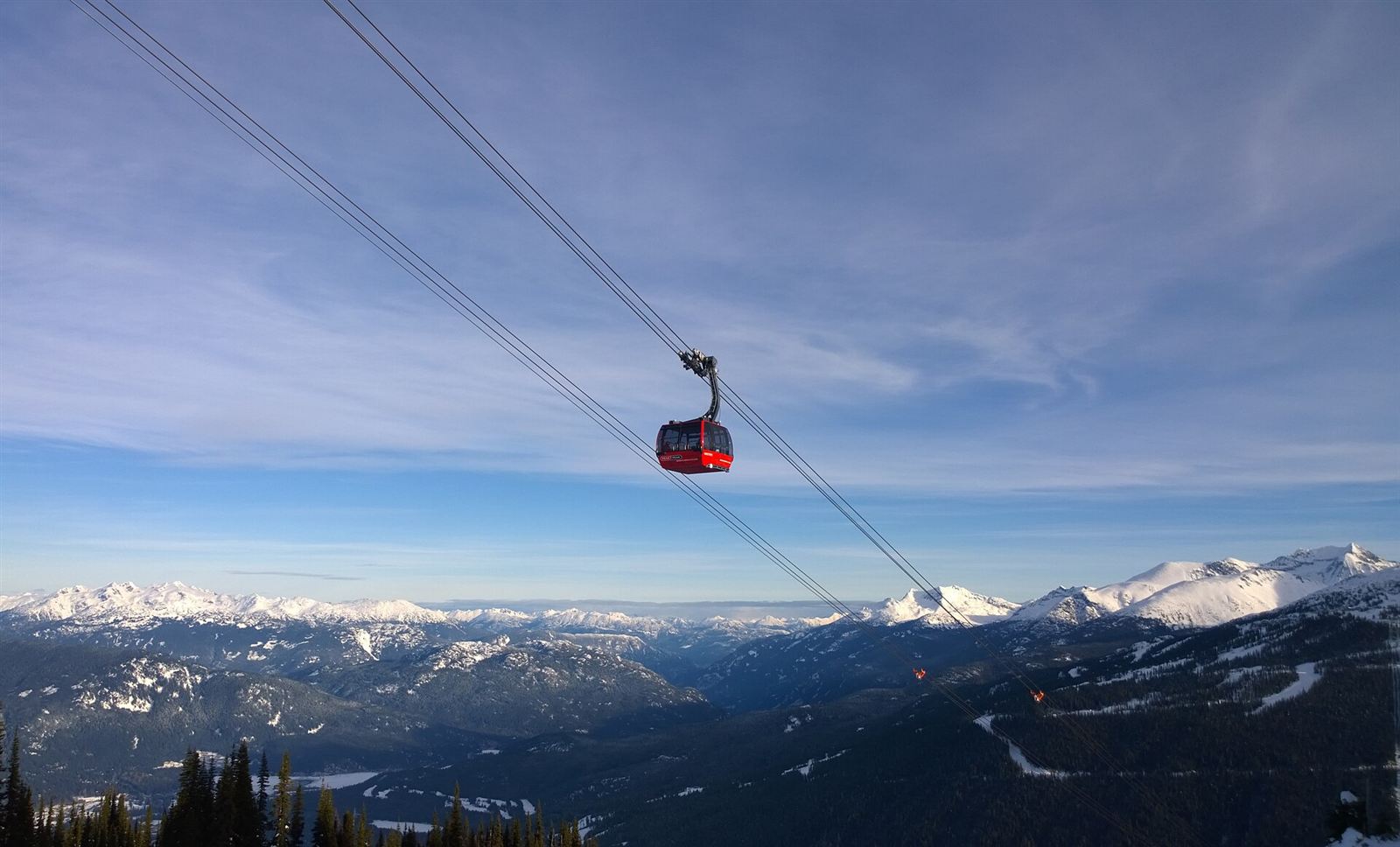
Thousands of installations have been built over the more than one hundred and fifty years of ropeway transport. A very small number of them changed not only the valley they stood in but the technical limits of the entire industry. The projects below mark the points at which ropeway engineering crossed a particular threshold: the moments when a new system type was born, a dimensional record was broken, or the cable car took on an entirely new function.
What makes an installation a milestone?
A ropeway project usually earns its place in the industry’s history through at least one of the following four headings:
- The first application of a new system type. A transport principle that until then existed only on paper being run in the field for the first time.
- A dimensional limit being surpassed. Reaching the highest value in a parameter such as free span, vertical rise, tower height, line length or cabin capacity.
- The widening of the field of use. The cable car taking on a function beyond skiing and tourism — urban public transport, border crossings, heavy materials handling.
- A change in the operating model. Automation, integrated ticketing or availability targets raising the industry standard.
The record itself is secondary from an engineering point of view; what matters is which technical problem had to be solved in order to reach it. For a general framework of system types, see the guide to cable car and ropeway types; for the full historical sweep, see the world history of the cable car.
The installations where system types were born
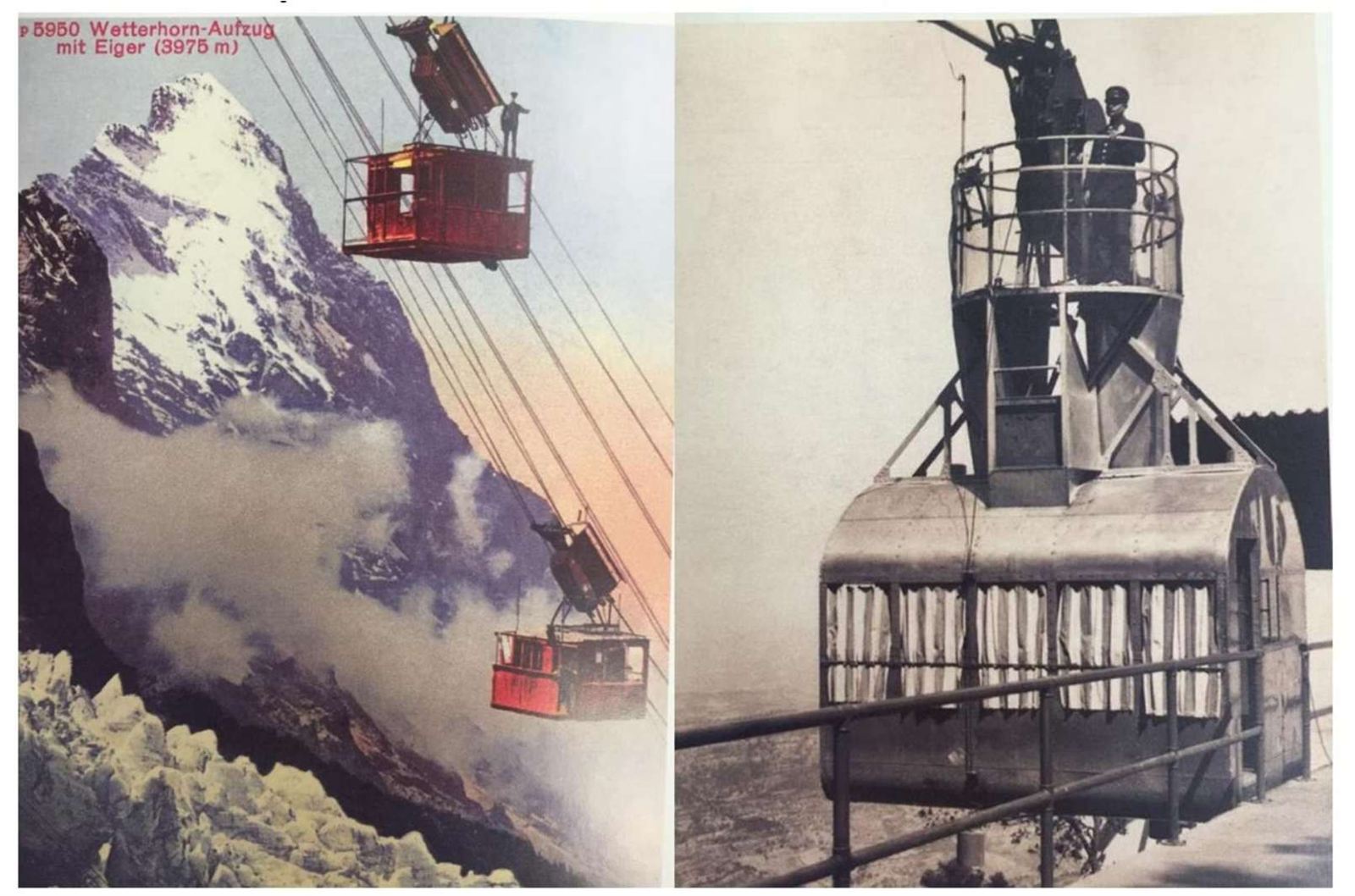
1908: entrusting the passenger to the rope
In the history of ropeway transport, 1908 is a threshold at which more than one first fell in the same year. The installation commissioned at the Wetterhorn in Switzerland is remembered as the first passenger cable car to break away from materials lines. That same year in Italy, the Kohlern line near Bozen became the first passenger application of what we today call a reversible ropeway (an aerial tramway).
The engineering value of the reversible principle lies in a simple balance behind the scenes: two cabins are attached to the same rope on opposite sides, one descending as the other ascends and acting as a counterweight. What the drive motor has to overcome is not the total load but only the load difference plus friction. This arrangement remains the most efficient solution on steep, short lines to this day.
1936–1949: solving the capacity problem
The spread of skiing forced a shift from the problem of “getting the passenger up the mountain” to the problem of “carrying thousands of passengers an hour in a continuous flow”. This transition has three nodal points:
- 1936, Sun Valley (USA): the first chairlift. Carrying passengers on chairs fixed to a continuously moving rope raised capacity far above that of reversible systems in one step.
- 1945, Flims (Switzerland): the first detachable chairlift. The vehicle detaching from the rope in the station and slowing down meant that the rope speed on the line became independent of the passenger’s boarding speed. This is perhaps the single most decisive idea in the industry: the link between comfort and capacity was broken.
- 1949, Belvedere / Alagna Valsesia (Italy): the first gondola lift. The enclosed cabin took the system beyond the ski season and beyond fair weather.
The article on how cable cars work offers a detailed framework on how the detachable grip operates and why the rope–grip interaction is so critical.
1984–1991: stability through the number of ropes
In monocable systems, the same rope does both the carrying and the hauling. This leaves the vehicle on the line vulnerable to wind. The 1980s and 1990s saw the birth of three system types that solved this vulnerability by increasing the number of ropes:
- DMC (Double Mono Cable), 1984, Serre Chevalier (France). Two parallel carrying-hauling ropes.
- Funitel, 1990, Val Thorens (France). The vehicle hangs from two widely spaced ropes on four grips. The increased width of the suspension directly suppresses swing.
- 3S (tri-cable gondola), Saas-Fee (Switzerland). In this arrangement, developed by Von Roll, two fixed track ropes carry the weight of the vehicle while a third haul rope provides the movement. The first application, the Alpin Express line, was commissioned in 1991; some industry chronologies date the installation to 1990. When Von Roll’s ropeway division was transferred to Doppelmayr in 1996, the 3S expertise changed hands with it, and the system became widespread in the 2000s.
The significance of the 3S can be summed up in a single sentence: it sits at the top of the ranking for wind resistance. That ranking begins with the continuously circulating monocable gondola and continues through the Funifor and the aerial tramway, with the 3S at the end of it. It is also the only system that permits very long spans and large cabins — almost every record that follows belongs to this family. For the reasons why track ropes and haul ropes are manufactured to different constructions, see the article on ropeway wire ropes.
The two installations that carry the dimensional records
Peak 2 Peak (Canada, 2008): the limit of the unsupported span
Peak 2 Peak, which connects the Whistler and Blackcomb mountains, crosses the valley between the two in a single stroke. The installation has a total line length of 4,400 metres, but its defining feature is the 3,024-metre unsupported span between two towers; the cabins travel at a height of up to 436 metres above the valley floor. Both figures were world records on opening.
From an engineering point of view, the issue here is this: putting a tower in the valley means opening a construction site on the steep slopes between two mountains and getting maintenance crews there for years afterwards. Lengthening the span makes the tensioning of the track rope and the sag calculation harder, but it removes the construction and operating burden altogether. The 3S system made that trade-off possible.
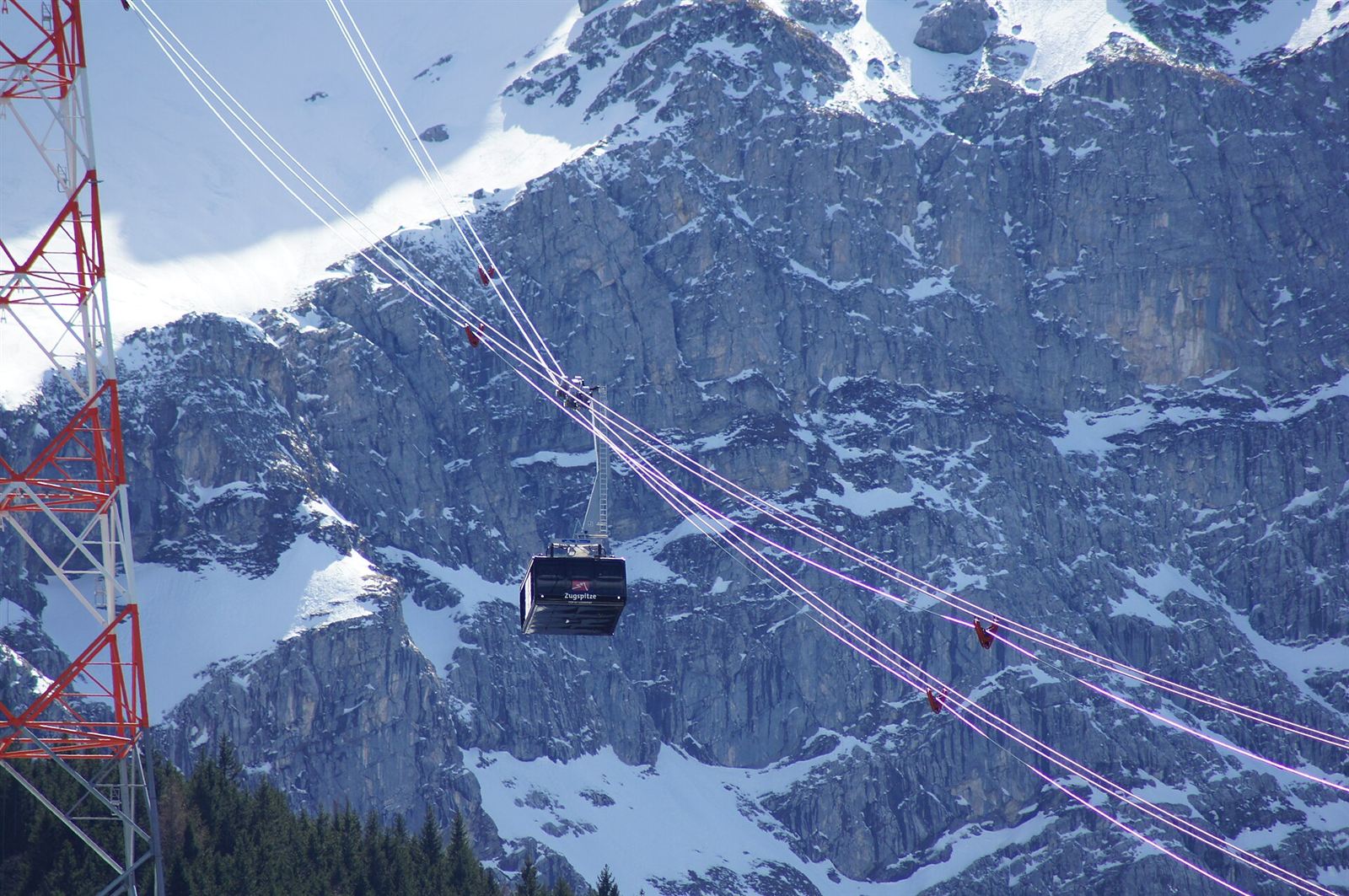
Zugspitze (Germany, 2017): three records in one installation
The installation linking the Eibsee with the summit of the Zugspitze replaced a line dating from 1962 and brought three separate world records on opening:
- The world’s tallest steel cable car tower: 127 metres
- The greatest vertical rise in a single section: 1,945 metres
- The longest free rope span: 3,213 metres
These three figures are not independent of one another. Reaching the summit without an intermediate station required a very large difference in altitude to be overcome in a single section, which in turn required an extraordinarily tall tower at a single point and for the distance between to be crossed unsupported. The records are the consequence of a design decision, not its aim.
High altitude and a border crossing: Zermatt
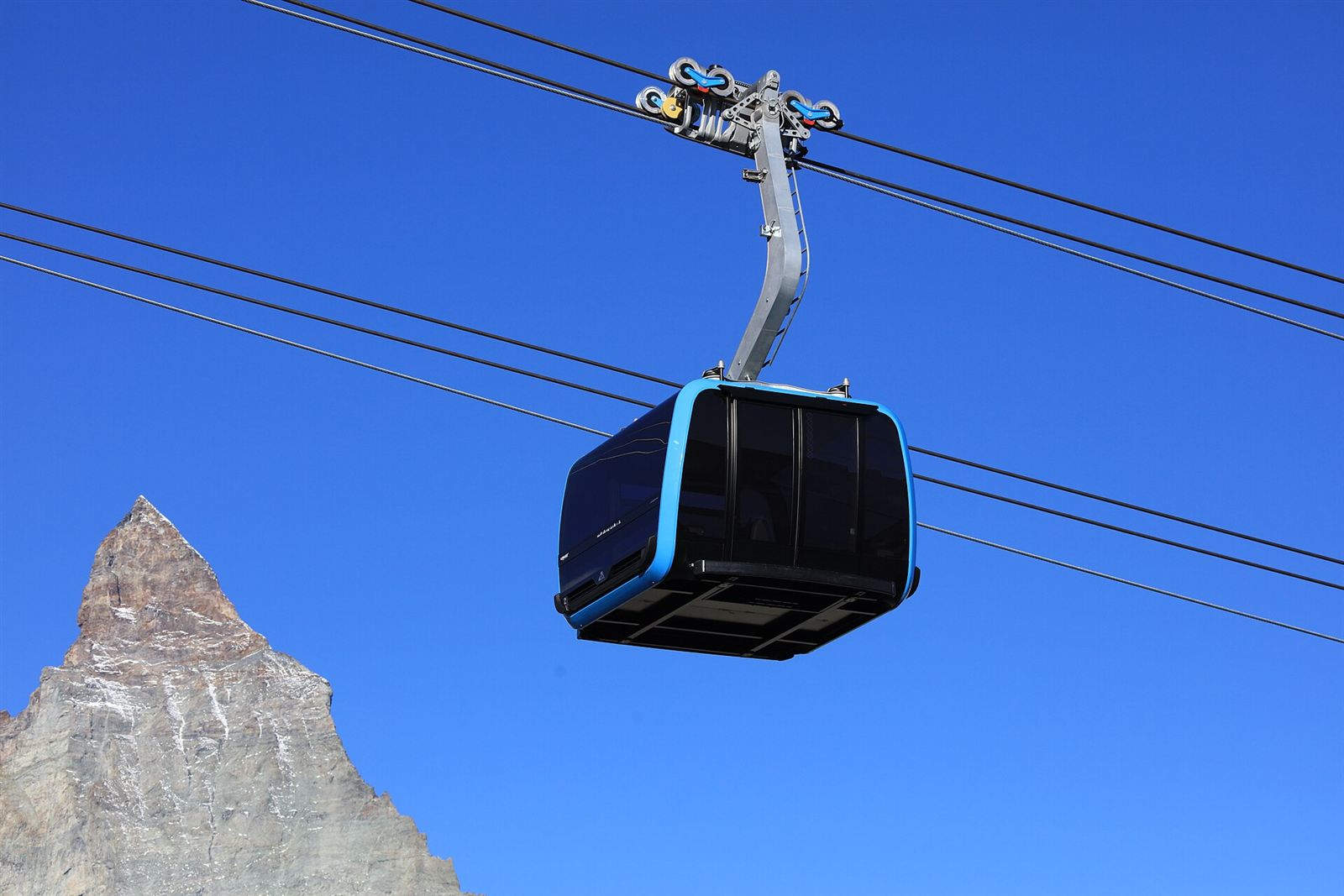
The Matterhorn Glacier Ride, opened in the Swiss village of Zermatt in 2018, is a 3S line connecting Trockener Steg with the Klein Matterhorn, and is known as the highest-altitude 3S system in operation anywhere in the world. The upper station stands at an elevation of roughly 3,880 metres and is one of the highest cable car stations in Europe.
At this altitude the design criteria change: icing, low air density, sudden wind gusts and foundation settlement caused by glacier movement all have to be taken into account. The second section (Alpine Crossing), commissioned in 2023, reaches Testa Grigia on a line of roughly 1.7 kilometres with no towers at all, establishing the highest ropeway crossing of the Swiss–Italian border in the Alps. Zermatt is also where the operating model changed: the world’s first autonomous operation (AURO) gondola was commissioned here in 2020.
The cable car comes down into the city
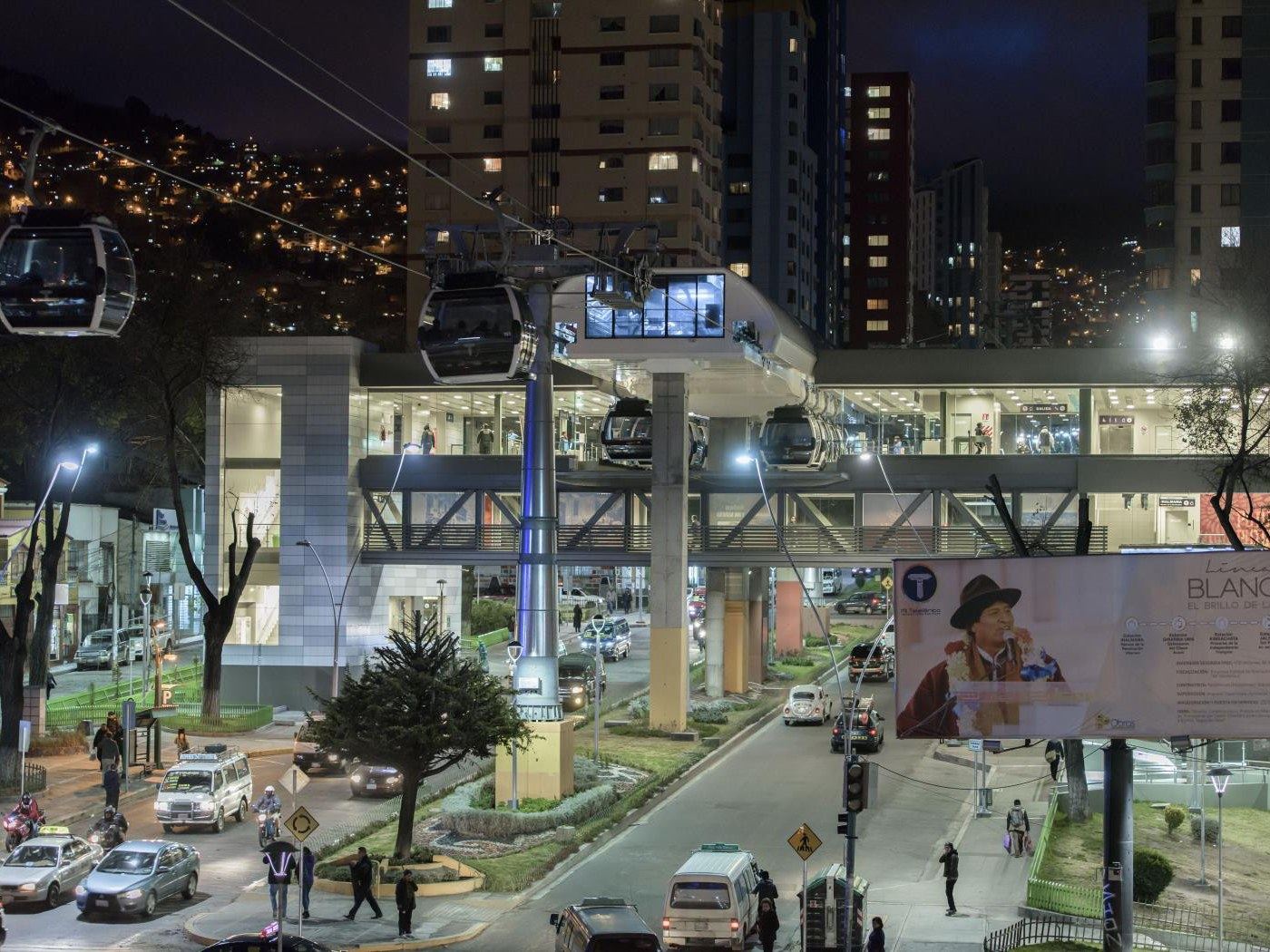
The most distinct break of the twenty-first century is the cable car ceasing to be an extension of mountain tourism and becoming an urban transport mode in its own right.
Medellín Metrocable (Colombia, 2004)
Line K, opened in 2004, is recognised as the first aerial cable car line to be fully integrated into a metro fare system and station structure. Neighbourhoods built on the steep slopes of Medellín in Colombia, which took hours to reach by bus, were connected directly to the metro network. The Metrocable has today grown into a network of six lines.
The innovation here is not technical but institutional: for the first time, a cable car was planned and priced not as a separate tourist attraction but as a line of the transport network.
La Paz Mi Teleférico (Bolivia, 2014)
The difference in level of up to 400 metres between La Paz and El Alto made conventional rail systems uneconomic. Opened with its first lines in 2014, Mi Teleférico reached 10 lines and a total length of roughly 33 kilometres in 2019, and was certified as the world’s largest public transit cable car network.
From an engineering point of view, the real achievement here is not the length but the continuity and availability. A cable car that forms part of an urban network is expected to do something never asked of a ski resort installation: to run every day of the year, at every hour of the day. That in turn means rewriting maintenance planning, spare parts strategy and rescue scenarios from scratch — for a framework on the subject, see the article on cable car maintenance and rescue.
Other urban examples
| Project | Year | Notable aspect |
|---|---|---|
| London (Thames crossing) | 2012 | River crossing integrated with the city transport card |
| Mexico City Cablebús | 2021 | Line 2, at 10.6 km, the longest urban cable car line |
| Toulouse Téléo | 2022 | A 3 km 3S; a university–hospital campus connection |
| Paris Câble C1 | 2025 | 4.5 km, 5 stations; an aerial extension of a metro line |
What these lines have in common is that all of them have been added to the end of an existing rail system. The urban cable car has positioned itself not as a competitor to the metro but as a means of connecting to it the topography the metro cannot reach.
Records of scale: Ha Long
The Queen Cable Car, opened in the Vietnamese city of Ha Long in 2016, broke records in two areas at once: a tower height of 188.88 metres and a cabin capacity of 230 passengers. Although the tower record has since passed to another installation in Vietnam, what the project demonstrated is enduring: reversible systems working with double-deck and very large cabins can carry passengers on the scale of a metro carriage in a single trip. The price of that is a complete rethink of the rope and drive sizing, the station platform layout and the evacuation planning.
Another example of the same pursuit of scale is Ngong Ping 360, built in Hong Kong in the mid-2000s on a line of roughly 5,800 metres.
The line from Türkiye that makes the list
The Bursa Uludağ line appears in this picture twice. Built by the Swiss manufacturer Von Roll between 1958 and 1963, the installation opened on 29 October 1963 as the first cable car in Türkiye; the 4.5-kilometre line had two cabins of 20 people each running in opposite directions. After the 2014 modernisation, the line rose to 8.8 kilometres and became, on opening, the world’s longest monocable gondola line. For the installation’s detailed data sheet and history, see the article on the Bursa Uludağ Cable Car.
The common lesson
When you set the data sheets of these installations side by side with the eye of a technical operator, it becomes clear that none of the records was an end in itself. The Zugspitze’s 127-metre tower is the consequence of avoiding an intermediate station, Peak 2 Peak’s 3-kilometre span the consequence of not opening a construction site in the valley, and La Paz’s 33-kilometre network the consequence of connecting a city of steep slopes economically.
The driving factors that OITAF lists for the evolution of the industry confirm this: increased performance, comfort, energy efficiency, reduced environmental and visual impact, standardisation and automation. Beneath all of these factors lies a single unchanging common denominator — the pursuit of safety. For the standards and inspection structure that is the institutional expression of that pursuit, see the article on cable car safety and EN standards.