
The Uludağ Cable Car is a ropeway installation linking Bursa city centre to the hotels zone on Uludağ. The installation holds a special place in Türkiye’s cable transport history because it carries two separate turning points along one and the same route: it opened in 1963 as the country’s first cable car, and with the complete rebuild of 2014 it was recorded, as of its opening, as the world’s longest monocable detachable gondola line.
This article sets out, in one place, the installation’s history, the technical characteristics of the two generations of system, the route and station structure, and what the line means for urban transport and tourism.
Geographical context: why a cable car?
Uludağ is a massif that rises immediately south of the Bursa plain and whose summit exceeds 2,500 metres. The vertical difference between the city centre and the hotels and ski facilities on the mountain reaches 1,400 metres. By road, that distance is covered along a route of more than thirty kilometres which winds around the northern flank of the mountain and is directly exposed to snow and ice in the winter months.
Ropeway systems are at their most advantageous in exactly this kind of topography: the line can run in a straight path over valleys and forest cover, gain height across a short horizontal distance, and operate largely independently of road conditions. This was essentially the rationale for the Uludağ line both in 1963 and in 2014. For the differences between system types, the guide to cable car and ropeway types offers a detailed framework.
The first line: 1958–1963
Construction
Construction of the line was awarded to the Swiss firm Von Roll. Von Roll was a long-established manufacturer: born in 1803 as an ironworks, it entered the cable transport sector in 1883 with the Territet funicular and took part in the first passenger cable car at the Wetterhorn in 1908.
Construction began in 1958 and took five years. In the conditions of the day, the tower foundations on the mountainside, the station buildings and the transport of materials were met largely by human labour; the site was worked on wooded terrain with steep slopes.
Opening and technical characteristics
The line entered service on 29 October 1963, in the 40th year of the Republic. The Uludağ Cable Car thus became Türkiye’s first cable car.
The 1963 system had an architecture entirely different from today’s gondola logic:
| Feature | 1963 system |
|---|---|
| Manufacturer | Von Roll (Switzerland) |
| System type | Aerial tramway (reversible) |
| Line length | About 4.5 km |
| Intermediate stations | Kadıyayla, Sarıalan |
| Number of vehicles | 2 cabins running in opposition |
| Cabin capacity | 20 people |
| Hourly capacity | About 120 people |
In a reversible system the two cabins are attached to the two ends of the rope and move in opposite directions: as one climbs, the other descends. This arrangement does not provide high capacity, but it does make it possible to cross long spans with a small number of vehicles. A capacity of 120 journeys an hour was enough, at the scale of its era, to change access to Uludağ from the ground up.
Fifty years of service
For half a century the line was the infrastructure that defined Bursa’s relationship with the mountain. Uludağ’s development as a winter sports centre, and its adoption as “Bursa’s mountain”, are largely bound up with the access it provided.
The system stopped running on 29 October 2013, exactly fifty years after it opened, and was dismantled to make way for the new installation. Falling on the same calendar day, this closure allowed the installation to complete its life symmetrically.
A human story: “Alman Amca”
Hubert Sondermann (1902–1976), Von Roll’s site engineer, came to Bursa in 1958 as the representative of the firm that had won the tender. He was a mechanical engineer, born in Germany and trained in Switzerland.
Sondermann lived in the city throughout the construction, learned Turkish and became known among local people as “Alman Amca” (the German uncle). In the last part of his life he advised on the chairlift projects of the hotels on Uludağ. He died in Bursa in 1976 and, in accordance with his will, was buried in Emir Sultan Cemetery. In this respect the technical story of Türkiye’s first cable car also turned into a story of settling down.
The 2014 rebuild
The decision and its scope
In the early 2010s the decision was taken to rebuild the line completely. The reasons complemented one another in technical and operational terms: capacity on the fifty-year-old installation was inadequate, the equipment had reached the end of its life, and the line did not extend as far as the hotels zone. Beyond Sarıalan, passengers had to continue by road.
The new installation was designed and equipped by the Italian firm LEITNER ropeways and delivered under a build-operate-transfer model; the operating rights were transferred under a long-term contract. The installation is owned by Bursa Metropolitan Municipality and operated by Teleferik Holding.
System type
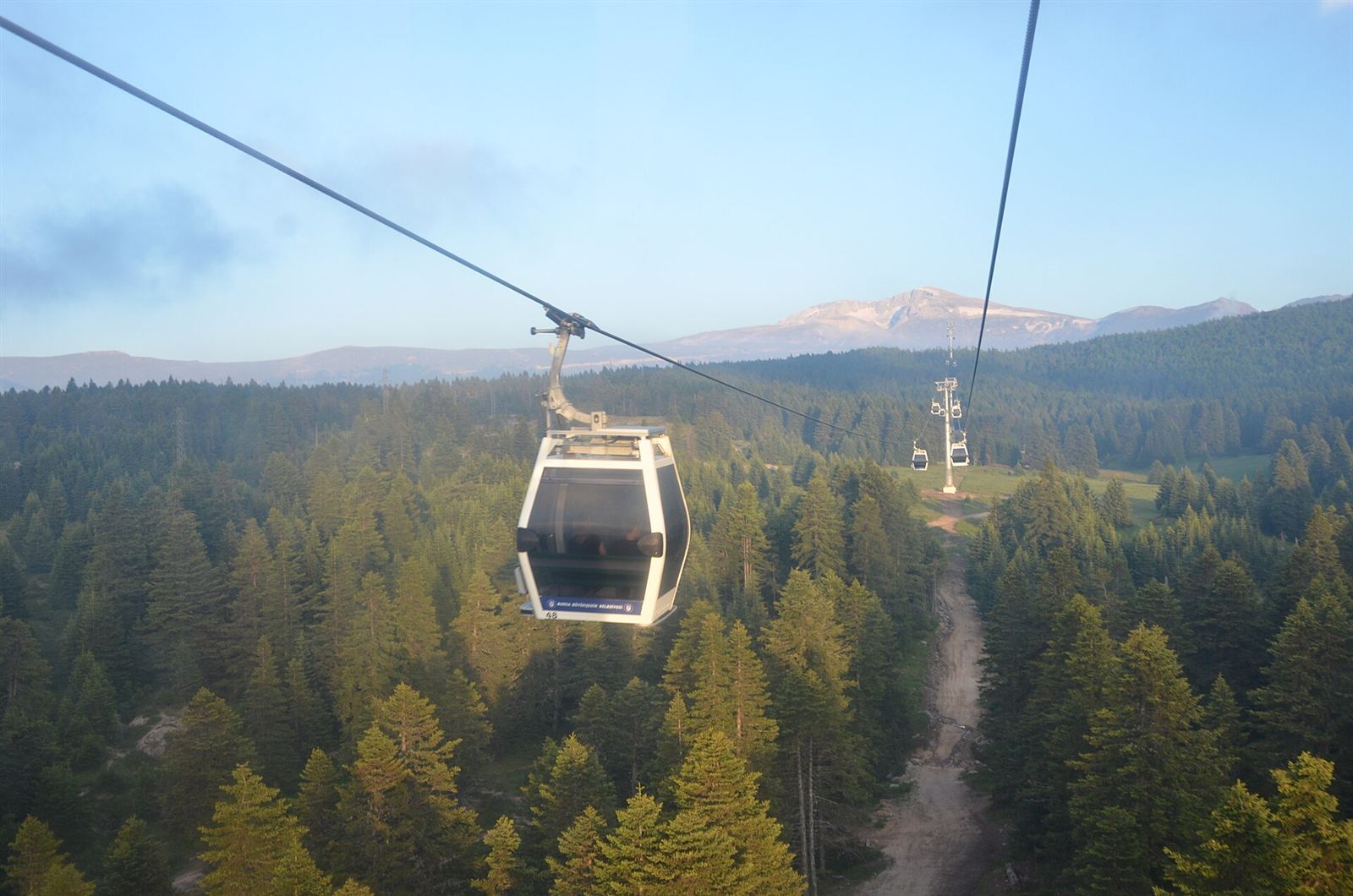
The new line is of the monocable detachable gondola (MDG) type. In this type a single rope acts as both carrying and hauling rope; at the stations the cabins are detached from the rope by a dedicated mechanism, slowed down, and then re-accelerated and re-attached to the rope once passengers have boarded and alighted.
The practical consequence of this architecture is that while the vehicles travel along the line at high speed, boarding at the stations takes place at walking pace. This detachable coupling mechanism, known as the grip, is one of the most closely monitored components of modern gondola installations from a safety point of view.
Route and stations
The line consists of four stations and runs from the foot of the city up to the hotels zone:
| Station | Approximate elevation | Location |
|---|---|---|
| Teferrüç | Foot of the city | Yıldırım, Bursa — bottom station |
| Kadıyayla | ~1,230 m | Intermediate station |
| Sarıalan | ~1,630 m | Intermediate station, recreation area |
| Hotels Zone (Kurbağakaya) | ~1,810 m | Top station, ski resort |
The line is not a single uninterrupted rope loop; in the manufacturer’s records it is defined as consecutive sections, with a change of vehicle at the stations that mark the section boundaries. The longest stretch is the roughly 4.2-kilometre section between Sarıalan and the Hotels Zone.
Commissioning took place in two phases. The Teferrüç–Sarıalan section opened to passenger service on 7 June 2014; the section connecting Sarıalan to the hotels zone entered service at the end of December that same year. With this second phase, Sarıalan ceased to be the terminus and became an intermediate station.
Technical data
| Parameter | Value |
|---|---|
| Manufacturer | LEITNER ropeways (Italy) |
| System type | Monocable detachable gondola (MDG) |
| Entry into service | 2014 (in two phases) |
| Line length | 8,838 m (about 8.8 km) |
| Vertical rise | About 1,400 m |
| Hourly capacity | 1,500 pph |
| Cabin type | GD8 — 8-person |
| Line speed | About 6 m/s |
| Number of stations | 4 |
Adding the sections together, the journey time is roughly 20–25 minutes: Teferrüç–Sarıalan takes about 12 minutes and Sarıalan–Hotels Zone about 10 minutes. Once transfer times are included, an end-to-end journey can in practice reach thirty minutes.
Discrepancies in published figures
Some of the figures relating to the installation vary from source to source, and these differences should be borne in mind while reading:
- Number of cabins: the manufacturer’s data sheet gives 176, the operator’s presentation 156 and encyclopaedic sources 140. Because the number of vehicles run on the line of a gondola installation can be varied according to season and demand, differences of this kind are normal; the maximum number of vehicles available need not be the same as the number actually on the line.
- Number of towers: values ranging between 44 and 49 have been published.
- Line length: figures varying between 8,800 and 8,838 metres differ according to the measurement reference used.
This article takes the values in the manufacturer’s data sheet as its basis, and the discrepancies have been stated explicitly.
What it means for the city
The Uludağ Cable Car performs three distinct functions for Bursa.
Access for winter tourism. The line provides access to the hotels zone independently of road conditions. In periods when snow and ice make the mountain road difficult, this connection becomes decisive.
Day-trip recreation. The Sarıalan recreation area and the forest cover at the intermediate elevations free the line from being tied to the winter season alone. A steady flow of visitors is generated throughout the year.
A civic landmark. The mark that the first line left on Bursa’s identity over fifty years has been carried over to the rebuilt installation. It continues to be one of the first installations that come to mind when cable cars in Türkiye are mentioned.
For a comparative inventory of the other installations in Türkiye, see the guide to Türkiye’s major cable car and ropeway installations; and for the whole story of how the sector developed in the country, see the history of cable cars in Türkiye.
Maintenance and inspection
A long mountain line brings certain obligations with it in operating terms. A route of roughly nine kilometres, more than forty towers and over a hundred vehicles mean a broad inventory of components that requires a regular inspection regime.
On ropeway installations the maintenance regime is made up of daily, weekly, monthly and annual layers of checks; for the ropes, magnetic non-destructive testing forms part of the periodic inspection. According to industry data, the maintenance effort an installation receives over a season can exceed its actual operating time.
The factor that most directly determines operation on mountain lines is wind. Depending on anemometer readings, line speed is reduced or services are suspended; icing and visibility conditions steer operating decisions in a similar way. For the details of these topics, see cable car maintenance and rescue.
Summary
The Uludağ Cable Car is an installation that holds two different generations of technology along one and the same route. The 4.5-kilometre aerial tramway opened in 1963 under the Von Roll name was Türkiye’s first aerial experience of cable transport, and it served for fifty years. The roughly 8.8-kilometre gondola line built by LEITNER in 2014 connected the city centre directly to the hotels zone with a capacity of 1,500 passengers an hour.
The technical value of the installation lies less in a single record claim than in the ability to operate a long mountain route continuously and reliably. That in turn is possible only when the design, manufacturing and operating links are joined to one another without a break.